
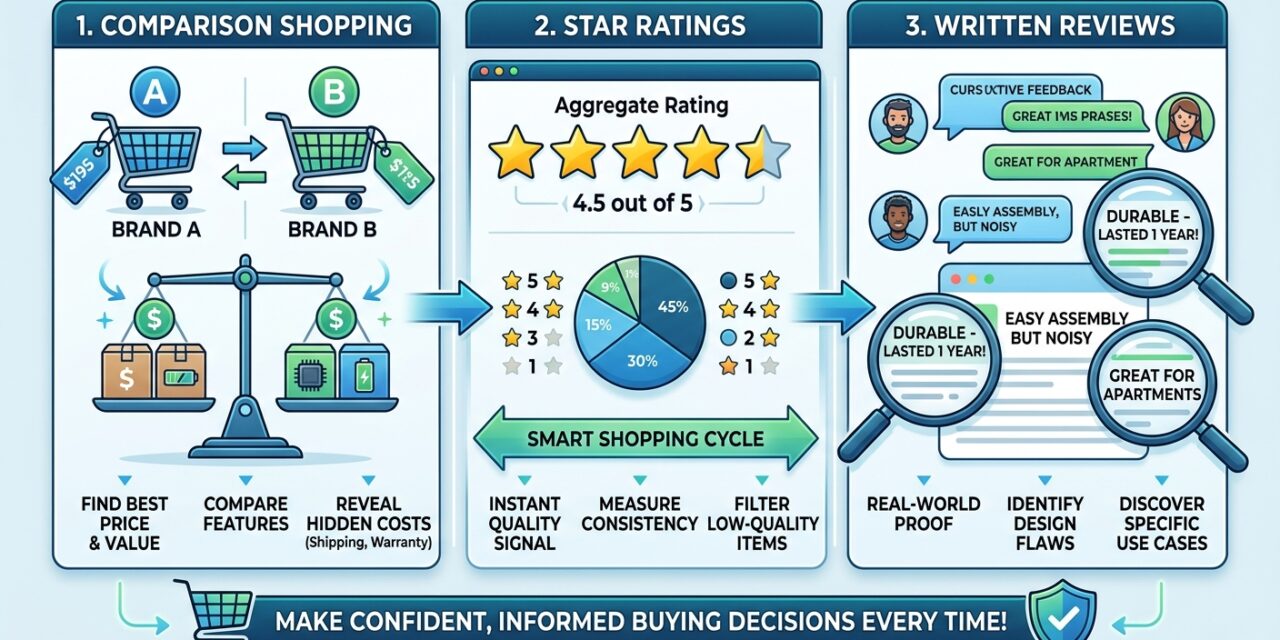
In today’s crowded digital marketplace, buying the first product you see is a fast track to buyer’s remorse. Comparison shopping, along with analyzing customer ratings and reviews, acts as an essential decision-making system that protects your wallet and guarantees product quality.
Here is why each component of smart shopping matters.
1. Comparison Shopping: Maximizing Value and Quality
Comparison shopping goes beyond finding the lowest price—it ensures you get the best value for your money.
- Price Optimization: Prices for identical or equivalent items vary wildly across retailers due to localized promotions, dynamic pricing algorithms, and exclusive seller margins.
- Feature Alignment: Comparing specs side-by-side ensures you do not overpay for features you will never use, or inadvertently buy an underpowered alternative.
- Hidden Cost Visibility: Side-by-side evaluation reveals costs that are not apparent upfront, such as shipping fees, warranty terms, return policies, and subscription requirements.
2. Star Ratings: The Macro Quality Signal
Star ratings provide an immediate, quantitative snapshot of overall customer satisfaction based on large sample sizes.
- Efficient Filtering: High-level ratings allow you to instantly filter out low-quality items without wasting time reading dozens of individual feedback entries.
- Statistical Reliability: An aggregate rating calculated from thousands of users provides a reliable benchmark of consistency and manufacturing quality control.
- Expectation Setting: A product with a 4.5-star average generally indicates low risk, while products hovering below 4.0 often signal recurring issues.
3. Written Reviews: Qualitative Proof and Nuance
While ratings give you the “what,” written reviews provide the “why.” They serve as real-world field test reports from everyday consumers.
- Long-Term Durability: Product descriptions showcase brand-new performance, but customer reviews reveal how a product holds up after 3, 6, or 12 months of daily use.
- Uncovering Design Flaws: Reviews highlight specific, non-obvious issues—such as poor fit, confusing setup processes, noisy operation, or weak battery life.
- Real-World Context: Reviewers often share their exact use cases (e.g., “Great for apartments, but too weak for house-wide cleaning”), helping you determine if a product fits your specific situation.
How They Work Together
| Component | Primary Function | What It Reveals |
| Comparison Shopping | Assesses Value | Market pricing, feature trade-offs, and alternative options |
| Ratings | Measures Consensus | Broad customer satisfaction and product reliability at a glance |
| Reviews | Delivers Context | Specific pros/cons, real-world durability, and practical trade-offs |
Combining all three steps shifts the advantage back to you, turning potentially risky purchases into confident investments.

